
The WooCommerce System Status report is handy for troubleshooting issues with your store. Containing a wide variety of information and tools, you can check software versions, server settings, and more from within.
To view your System Status report:
- Go to: WooCommerce > Status.
- Troubleshoot using the info below, before opening a ticket at Woo Support.
- Select Get System Report and copy/paste it into your Support Ticket, if you’re still having issues. The information included will help our support team narrow down the issue much quicker.
WordPress Environment ↑ Back to top
This provides general information about your site and WordPress installation, and features you have enabled.
| Field Name | Description | Example |
|---|---|---|
| Home URL | URL of your site’s homepage. | http://example.com |
| Site URL | Root URL of your site. | http://example.com |
| WC Version | Version of WooCommerce installed on your site. | 3.0.0 |
| Log Directory Writable | Whether the WooCommerce log directory is writable, and the location. | /srv/www/wp-content/uploads/wc-logs/ |
| WP Version | Version of WordPress installed on your site. | 4.7.3 |
| WP Multisite | Whether you have WordPress Multisite enabled. | No |
| WP Memory Limit | Maximum memory (RAM) that your site can use at one time. Learn how to increase this limit here. | 256 MB |
| WP Debug Mode | Displays whether WordPress is in Debug Mode. | – |
| WP Cron | Displays whether WordPress Cron is enabled. | √ |
| Language | Current language used by WordPress. Default = English | en_US |
| External Object Cache | Whether WordPress is using an external cache. | √ |
Server Environment ↑ Back to top
This provides general information about your server.
| Field Name | Description | Example |
|---|---|---|
| Server Info | Information about the web server currently hosting your site. | nginx / apache |
| PHP Version | Version of PHP installed on your hosting server. | 7.0.17 |
| PHP Post Max Size | Largest file size that can be contained in one post. | 100 MB |
| PHP Time Limit | Amount of time in seconds that your site spends on a single operation before timing out (to avoid server lockups). | 300 |
| PHP Max Input Vars | The maximum number of variables your server can use for a single function to avoid overloads. | 6144 |
| cURL Version | Version of cURL installed on your server, if any. | 7.53.1, OpenSSL/1.0.1t |
| SUHOSIN Installed | Suhosin is an advanced protection system for PHP installations. It was designed to protect your servers against a number of well-known problems in PHP applications; and also against potential unknown vulnerabilities within these applications or the PHP core itself. If enabled on your server, Suhosin may need to be configured to increase its data submission limits. More info at: Data not saving variations and rates. | – |
| MySQL Version | Version of MySQL installed on your hosting server. | 5.5.5-10.1.17 |
| Max Upload Size | Largest file size that can be uploaded to your WordPress installation. | 100MB |
| Default Timezone is UTC | Whether the timezone for your server is UTC. | √ |
| fsockopen/cURL | Payment gateways can use cURL to communicate with remote servers to authorize payments. Other plugins may also use it when communicating with remote services. | √ |
| SoapClient | Some Web services use SOAP to get information from remote servers, e.g., Live shipping quotes from FedEx require SOAP be installed. | √ |
| DOMDocument | HTML/Multipart emails use DOMDocument to generate inline CSS in templates. | √ |
| GZip | GZip (gzopen) is used to open the GEOIP database from MaxMind. | √ |
| Multibyte String | Multibyte String (mbstring) functions are used to support UTF-8 characters. | √ |
| Remote Post | PayPal uses this method of communication when sending back transaction information. More info at: wp_remote_post Codex page. | √ |
| Remote Get | WooCommerce plugins may use this method of communication when checking for updates. | √ |
Database ↑ Back to top
This tells you your current database version, and lists all database tables and whether or not they exist.
| Field Name | Example | |
|---|---|---|
| WC Database Version Version of WooCommerce that the database is formatted for. |
3.7.0 | |
| Database prefix | wp_ | |
| Total Database Size | 2.06MB | |
| Database Data Size | 8.48MB | |
| Database Index Size | 2.21MB | |
| wp_woocommerce_sessions | √ | |
| wp_woocommerce_api_keys | Data:0.02MB + Index: 0.05MB + Engine InnoDB | |
| wp_woocommerce_attribute_taxonomies | Data:0.02MB + Index: 0.05MB + Engine InnoDB | |
| wp_woocommerce_downloadable_product_permissions | Data:0.02MB + Index: 0.05MB + Engine InnoDB | |
| wp_woocommerce_order_items | Data:0.02MB + Index: 0.05MB + Engine InnoDB | |
| wp_woocommerce_order_itemmeta | Data:0.02MB + Index: 0.05MB + Engine InnoDB | |
| wp_woocommerce_tax_rates | Data:0.02MB + Index: 0.05MB + Engine InnoDB | |
| wp_woocommerce_tax_rate_locations | Data:0.02MB + Index: 0.05MB + Engine InnoDB | |
| wp_woocommerce_shipping_zones | Data:0.02MB + Index: 0.05MB + Engine InnoDB | |
| wp_woocommerce_shipping_zone_locations | Data:0.02MB + Index: 0.05MB + Engine InnoDB | |
| wp_woocommerce_shipping_zone_methods | Data:0.02MB + Index: 0.05MB + Engine InnoDB | |
| wp_woocommerce_payment_tokens | Data:0.02MB + Index: 0.05MB + Engine InnoDB | |
| wp_woocommerce_payment_tokenmeta | Data:0.02MB + Index: 0.05MB + Engine InnoDB | |
| wp_woocommerce_log | Data:0.02MB + Index: 0.05MB + Engine InnoDB | |
| wp_commentmeta | Data:0.02MB + Index: 0.05MB + Engine InnoDB | |
| wp_comments | Data:0.02MB + Index: 0.05MB + Engine InnoDB | |
| wp_failed_jobs | Data:0.02MB + Index: 0.05MB + Engine InnoDB | |
| wp_links | Data:0.02MB + Index: 0.05MB + Engine InnoDB | |
| wp_options | Data:0.02MB + Index: 0.05MB + Engine InnoDB | |
| wp_postmeta | Data:0.02MB + Index: 0.05MB + Engine InnoDB | |
| wp_posts | Data:0.02MB + Index: 0.05MB + Engine InnoDB | |
| wp_queue | Data:0.02MB + Index: 0.05MB + Engine InnoDB | |
| wp_termmeta | Data:0.02MB + Index: 0.05MB + Engine InnoDB | |
| wp_terms | Data:0.02MB + Index: 0.05MB + Engine InnoDB | |
| wp_term_relationships | Data:0.02MB + Index: 0.02MB + Engine InnoDB | |
| wp_term_taxonomy | Data:0.02MB + Index: 0.01MB + Engine InnoDB | |
| wp_usermeta | Data:0.02MB + Index: 0.02MB + Engine InnoDB | |
| wp_users | Data:0.02MB + Index: 0.01MB + Engine InnoDB |
Post Type Counts ↑ Back to top
This shows what post types exist on your store and how many posts exist within each type. Varies according to what plugins you have installed.
| Post Type Name | Count | |
|---|---|---|
| attachment | 16 | |
| customize_changeset | 3 | |
| nav_menu_item | 5 | |
| page | 7 | |
| post | 25 | |
| product | 36 |
Security ↑ Back to top
Displays whether your connection is protected. Errors should be hidden from untrusted visitors trying to view your information.

Active Plugins ↑ Back to top
This displays all WooCommerce-related plugins installed on your site. You can view current version numbers of your software and if any extensions have updates available.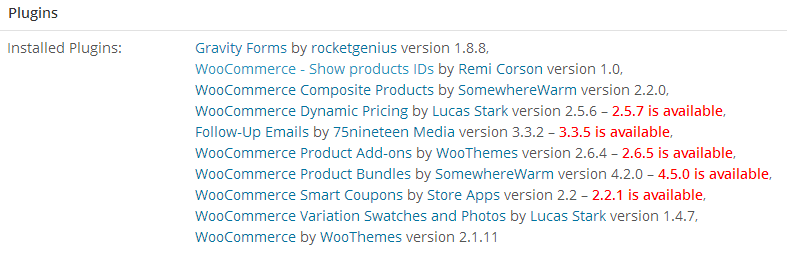
Settings ↑ Back to top
This shows general settings for your site.
| Field Name | Description | Example |
|---|---|---|
| API Enabled | Does your site have REST API enabled? | √ |
| Force SSL | Does your site force an SSL certificate for transactions? | √ |
| Currency | What currency are prices are displayed in and payments processed in | USD ($) |
| Currency Position | Position of the currency symbol when displaying prices. | left |
| Thousands Separator | Character used for a thousands separator in displayed prices. | , |
| Decimal Separator | Character used for decimal points in displayed prices. | . |
| Number of Decimals | Places shown after decimal points in displayed prices. | 2 |
| Taxonomies: Product types | Terms used for product types/statuses | booking, bundle, external, grouped, simple, subscription, variable |
| Taxonomies: Product visibility | A list of terms used for product visibility. | exclude-from-catalog, exclude-from-search, featured, outofstock, rated-1, rated-2, rated-3, rated-4, rated-5. |
WooCommerce Pages ↑ Back to top
This shows page IDs and Permalinks designated as WooCommerce pages.
For example: If your site is http://example.com, a user would get to the Cart page by going to http://example.com/cart/
| Field Name | Description | Example |
|---|---|---|
| Shop Base | URL of your WooCommerce shop’s homepage (along with the Page ID). | #3 – /shop/ |
| Cart | URL of your WooCommerce shop’s cart (along with the page ID). | #4 – /cart/ |
| Checkout | URL of your WooCommerce shop’s checkout (along with the page ID). | #5 – /checkout/ |
| My Account | URL of your WooCommerce shop’s “My Account” Page (along with the page ID). | #6 – /my-account/ |
| Terms and conditions | URL of your Terms and conditions page. (along with the page ID). | #361 – /my-account/ |
Theme ↑ Back to top
This displays information about the current theme running on your installation.
This could be a more problematic area of a site, as there is no standard on what themes should and should not do, and non-Woo themes can cause conflicts with WooCommerce or one of its extensions.
If you’re experiencing issues with your site, we recommend temporarily switching to the free Storefront Theme. If your problem is resolved while the Storefront theme is active, then the issue is with the theme. To resolve, check for updates or contact the theme developer to see if there is a fix.
| Field Name | Description | Example |
|---|---|---|
| Name | Name of the current active theme. | Storefront |
| Version | Installed version of the current active theme. | 2.5.1 |
| Author URL | Developer or theme URL | https://woocommerce.com |
| Child Theme | Whether the active theme is a child theme, and what the parent theme is. | x |
| WooCommerce Support | Whether the theme declares WooCommerce support. | √ |
Templates ↑ Back to top
This shows any files that override default WooCommerce template pages and also note if the templates are outdated.
If you are experiencing trouble with any of the pages displayed, switching to the Storefront theme will ensure that the original template files are used. For more information, see Fixing Outdated WooCommerce Template Files. For a long-term fix, you need to contact the theme developer.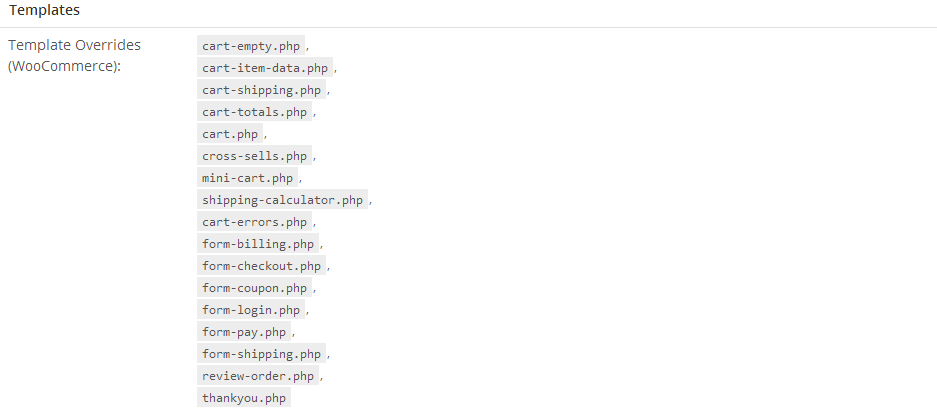
Subscriptions ↑ Back to top
Action Scheduler ↑ Back to top
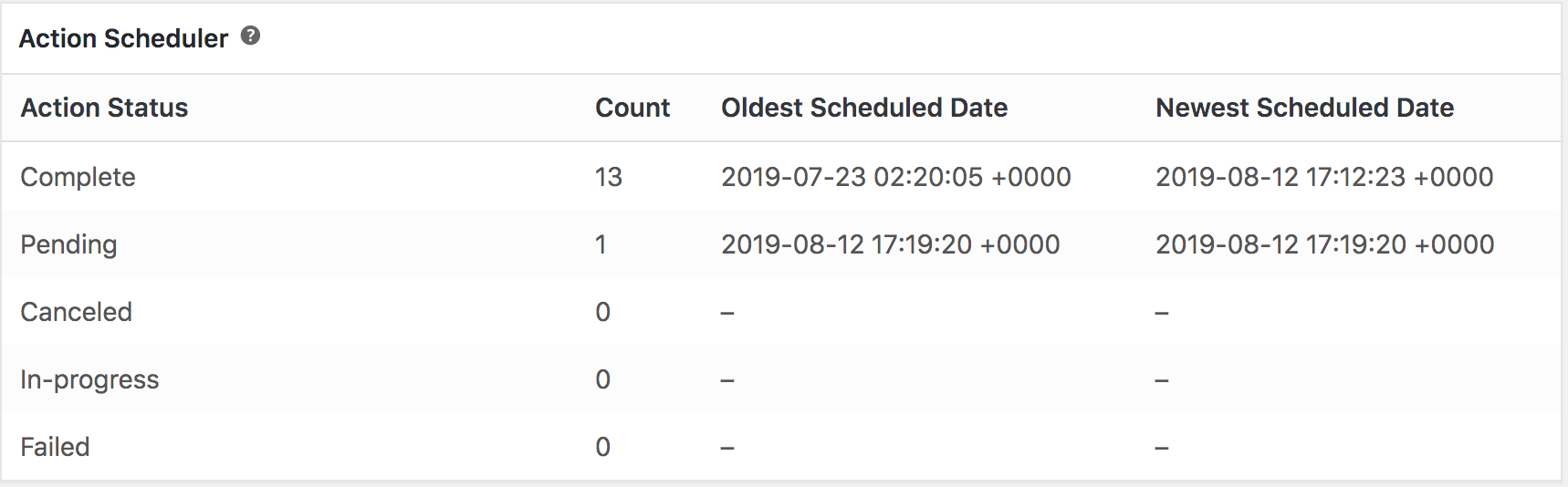
This shows scheduled action counts with previous and most recent dates.
In the Tools tab are helpful buttons that can address items such as user capabilities and customer sessions.
With transients you can clear both WooCommerce transients and all expired transients from WordPress with the Clear transients and the Clear expired transients buttons. Transients are a standardized way to store cached data temporarily in the database.
If you have a collection of variations that don’t have a parent you can remove those with one click using the Delete orphaned variations button. You can then order address indexes, which can help improve order search results.
Following that you can recount terms and reset capabilities. Recounting terms can be useful if you change any settings that hide products from the catalog and have issues from that. And if you find any users that can’t access all of the WooCommerce admin pages, resetting capabilities can be used in that case.
Clear customer sessions will remove any session data from the database. This includes any carts your customers are currently working on so use with caution.
Our next useful tool is the Create default WooCommerce pages button, if you’re having issues with WooCommerce pages or don’t want to create them one by one again you can select Install pages and it will create any missing WooCommerce pages. Pages already defined and set up won’t be replaced.
After that you can delete all the tax rates you’ve set in WooCommerce. If you were going to delete them anyway use this tool versus to going through each tax class and remove those rates one by one.
Finally you can delete WebHook logs and reset the usage tracking settings. When you first installed WooCommerce you may have opted in to send us non-sensitive data that helps us make WooCommerce better for everyone. You can opt out now by reseting your usage tracking settings.
The Logs tab is where WooCommerce keeps logs of all events happening in your store.
In the dropdown you can choose the level of logs you want to see, then select the Filter button to see events captured there. This can be useful to get exact errors with timestamps on parts of your store.

If your site experiences a fatal error, they may be logged here under a log named fatal-errors. This is useful when debugging.
By default, logs are kept for 30 days before being purged as of WooCommerce 3.4. This can be changed using the woocommerce_logger_days_to_retain_logs filter which defaults to 30.
Users of WooCommerce Services have a fourth tab that allows you check the health of Services, specific Services in use, a debugging section, and more.
Health displays the status of connected parts – if anything with WooCommerce or Jetpack needs attention, and if Services is up or down.
Services displays how specific Services are doing. Perhaps they’re unused, have an error needing attention, or working fine. You can enable debug logging to capture issues, and also contact our Support team to help configure your printer for printing shipping labels.